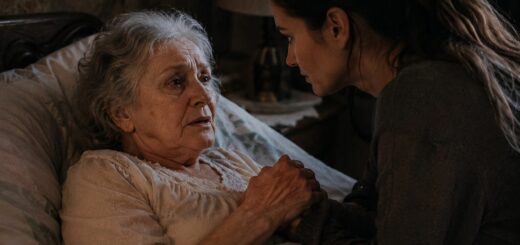
After my husband’s funeral, his brother handed me a sealed envelope with my name on it. there was only one key inside, and the note that was written there shocked me: “Don’t trust your children and……”
The funeral home had nearly emptied when Tom slid an envelope into my trembling hands. The creamy paper felt heavier than it should, as though it carried something denser than ink—secrets, perhaps. “Robert wanted you to have this,” Tom murmured, eyes fixed on the door where my children stood speaking with the funeral director. “Open it when you’re alone.” My husband of forty years lay in his coffin, and now his brother was handing me mysteries from beyond the grave. Tom’s fingers hesitated on the envelope, reluctant to release it. “Maggie…” he said softly. His tone made me meet his gaze. He’d been crying, but behind the grief was something sharper—warning, maybe. Fear. “Remember, Robert loved you more than anyone.” I waited until I was in the car, hands still shaking from the day’s weight. The parking lot was mostly empty under the dull October sky. Through the windshield, David was helping Rachel with her coat. They looked perfectly normal in their grief. The envelope tore open with a sound far too loud for the

silence. Inside was an old brass key with a small tag: 47, written in Robert’s meticulous hand. And the note—oh God, the note—made my heart stop.
My dearest Maggie, it began. If you’re reading this, I’m gone, and Tom has done what I asked. Everything I did was to protect you. Don’t trust our children. I know how that sounds, but please—trust me one last time. The truth is in unit 47 at Henderson Storage. Tom has the access code. He wrote of watching them dismiss me, belittle me, treat me as less than the woman who raised them. He wrote of my endless forgiveness. They don’t deserve you, he said.
I glanced at the funeral home. David was already scrolling on his phone. Rachel spoke animatedly on hers. Even in mourning, they were busy, detached. I’m sorry I couldn’t tell you while alive, Robert’s letter ended. You’d have confronted them, and they’d have twisted it. See them clearly now. All my love forever, Robert.
I stared at the key, its edges biting into my palm. Forty years of marriage, two children, a lifetime of dinners and memories—and now this cold metal promising to undo it all. Just six months earlier, our Sundays had been sacred. The house full of laughter, the scent of Robert’s ribeye drifting from the grill. David would arrive first with yellow roses. “For the prettiest woman here,” he’d say, kissing my cheek. Rachel followed with her husband and desserts—always her apple pie alongside a store-bought cake. “Backup and love,” she’d joke. Robert would grill, Rachel and I would set the table with my grandmother’s china, David would pour the wine—always serving me first. “Ladies before lawyers,” he’d quip. Robert would squeeze my hand under the table, pride shining in his eyes. Look what we made. I’d believe him when he said, “We did perfect.” Then came the diagnosis. Pancreatic cancer. Stage four. Maybe six

months, the doctor said. David and Rachel rushed in, already strategizing specialists and trials. For a moment, their determination felt like armor around us. But that evening I found them in Robert’s study, papers spread out like a blueprint of my husband’s life. “We need to be practical about the estate,” David said. “The house alone is worth two million.”
Rachel highlighted figures. “The investments, the Tahoe property…” They hadn’t asked how I was. They were divvying up his life as though he’d already gone. As Robert weakened, my children drifted from me, not him. They visited to share curated memories. “Dad, remember teaching me to throw a curveball?” David would say, as if I hadn’t been there too. I’d hand over Robert’s medication wordlessly, invisible. Nurses began addressing David instead of me, despite my notebook of every dose and symptom. One afternoon I made Robert’s favorite soup, one of the few things he could still eat. Carrying it upstairs, I overheard Rachel on the phone. “Mom’s falling apart. Thank God David and I are handling the important stuff.”
That night Robert squeezed my hand. “Good soup, Maggie,” he whispered. “Tastes like home.” I excused myself so he wouldn’t see me cry. When the hospice meeting came, David took my notes from me. “Let me handle this, Mom.” Rachel chimed in about my emotions clouding judgment. David even accused me of forgetting Robert’s medication. I tried to explain. It didn’t matter. By nightfall I’d signed papers giving them control. I’d signed myself out of my own life.
After the funeral, the house felt like a museum. David “safeguarded” Robert’s watch collection. Rachel boxed his books, keeping the first editions. But it was the garage—Robert’s sanctuary—that broke me. His entire workshop, gone. Tools stripped from the pegboard, the workbench vanished. Sitting on the cold floor, I sobbed until there was nothing left. Then I found a photo of our wedding day behind where the tool chest had stood. We had once believed we could survive anything. Three nights later, at two a.m., I drove to Henderson Storage. Unit 47 clicked open easily.
Inside was our true life. Our wedding china. My mother’s jewelry Rachel had claimed was lost. Each item wrapped carefully, Robert’s notes attached. Rachel said these were dated. They’re timeless, like you.
A folder marked TRUTH held bank statements for an account in my name only, funded by Robert for fifteen years. Enough for freedom. Enough to start over. Letters documenting every insult I had brushed aside. Copies of David and Rachel’s emails plotting to transfer everything before “Mom does something stupid.”
The grief remained, but underneath it, something else stirred—clarity. Robert had seen me drowning long before I realized it.
By dawn I called Tom. “I found everything.”
“Good,” he said. “What now?”
“I take my life back.”
I played the helpless widow well. When David called about settling the estate, I murmured vague agreements. When Rachel suggested a senior community, I nodded. Meanwhile, I met with a lawyer. Robert had placed everything in The Margaret Whitmore Living Trust. I controlled it all.
I recorded David when he threatened to have me declared incompetent. I photographed the papers Rachel brought me. My silence wasn’t surrender. It was strategy.
At the estate reading, David and Rachel arrived smug. Tom read Robert’s will: All assets under Mrs. Whitmore’s sole control.
They sputtered about mistakes and medication. Tom produced a video of Robert, gaunt but lucid: “If you’re seeing this, my children are trying to take everything from their mother. This ensures her dignity and control.”
I played their recorded voices plotting against me. “Your father knew exactly who you’d become,” I said steadily.
Tom handed them each an envelope. Their faces fell as they read the conditions: volunteer hours at my old school, a course in elder-care ethics, a ten-thousand-word essay on the value of teachers. Only upon completion would they receive fifty thousand dollars each—“a teacher’s annual salary,” Robert had noted.
I revealed the final blow: the house becoming The Whitmore House for Educators, a haven for retired teachers. “Everyone will praise Robert’s legacy,” I said. “And you’ll live with the shame.”
They threatened court. I welcomed it.
Now, months later, I stand in Robert’s restored workshop. His unfinished jewelry box sits on the bench. I run my fingers over the wood. His greatest gift wasn’t the money—it was reminding me who I am.
The Whitmore House for Educators opens next month. David has begun his volunteer hours; Rachel’s essays have softened. One line in her third essay made me cry: I watched my mother disappear in small surrenders I mistook for simplicity. She was never small. We just stopped seeing her magnitude.
I keep Robert’s last letter in the jewelry box, which I finished myself. Maggie, you were never ‘just’ anything. You were everything. Don’t let them make you small.
Afternoon light pours golden through the window. I am no longer the woman erased. I am the woman who remembered her size all along.